

Air Quality Data in the SSMP
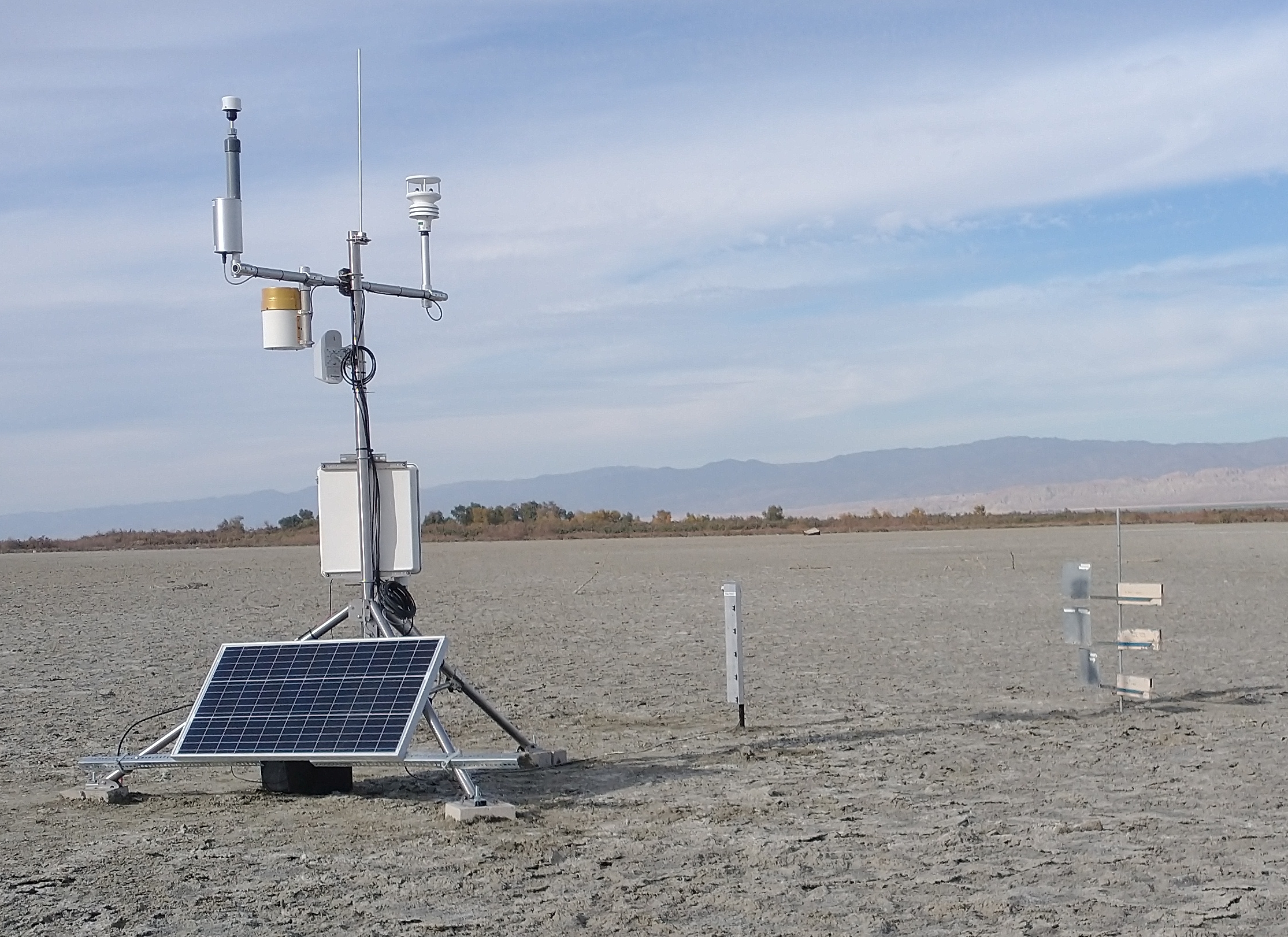
Salton Sea Management Program (SSMP) Air Quality Monitoring Program (Program) around the Salton Sea
The Program’s monitoring network is designed to support project-level performance and scientific understanding of dust generation processes at vegetation enhancement sites. The monitoring focuses on site-specific conditions, spatial and temporal variability, and relative changes over time rather than absolute concentration thresholds used for regulatory determinations. Regulatory compliance and enforcement are determined independently by the Imperial County Air Pollution Control Board or the South Coast Air Quality Management District, depending on site location and agency jurisdiction, under their respective statutory authorities.
Measured particulate matter concentrations at SSMP monitoring stations reflect integrated contributions from multiple regional and local sources and cannot be attributed to individual SSMP projects in isolation. For this reason, the Program emphasizes saltation measurements, evaluated using paired upwind and downwind monitoring locations, as a more direct indicator of surface stability and dust generation potential associated with SSMP projects. Saltation refers to the wind-driven movement of sand-sized particles along the surface and is a primary mechanism driver of fugitive dust emissions.
The SSMP monitoring network provides data to characterize spatial and temporal patterns of dust-related conditions and to evaluate the relative effectiveness of dust suppression measures implemented under the Program over time. Parameters measured include particulate matter (PM₁₀ and PM₂.₅), wind speed and direction, relative humidity, and saltation. High-precision sensors are used to conduct continuous measurements of these parameters. Due to the large volume of data collected, measurements are aggregated into 10-minute intervals to facilitate subsequent spatial and temporal analyses. Real-time and archived monitoring data are made publicly available to support transparency and scientific review; however, these data are provided for analytical and project-evaluation purposes only and are not suitable for regulatory compliance determinations.
The SSMP is not an air quality regulatory agency and does not operate or maintain air quality monitoring equipment to regulatory compliance standards. The monitoring network is not Federal Reference Method (FRM) or Federal Equivalent Method (FEM) certified. Accordingly, particulate matter (PM10 and PM2.5) data collected under the Program are non-regulatory and are not intended, and should not be interpreted, to assess compliance with Federal or State air quality standards.
Click the links below to access SSMP air quality data:
SSMP Realtime Air Quality data website
SSMP Archived Air Quality data download site
How SSMP Uses These Real Time and Archived Data
All real-time data undergo an extensive quality assurance and quality control (QA/QC) process and a cleaned, processed data set is produced. The wind, particulate matter, and saltation data help explain how winds transport dust, and how engineered roughness elements such as grass bales and established vegetation effectively reduce emissions on project areas. Data collected from monitoring equipment can be used to guide science-based decisions to protect public health and improve environmental conditions around the Sea.
How To Use This Data
Both real-time and QA/QC’ed versions of the SSMP air quality datasets are publicly available. Users can access real-time measurements of particulate concentrations, wind speed and direction, and other meteorological variables from each monitoring site to evaluate responses to individual wind events. Saltation data need additional processing and are available in the QA/QC’ed datasets. The QA/QC’ed data can be downloaded and imported into standard analytical tools.
By making these datasets accessible, the Program supports transparency and collaboration among researchers, agencies, and community groups working to understand and improve air quality in the Salton Sea region.